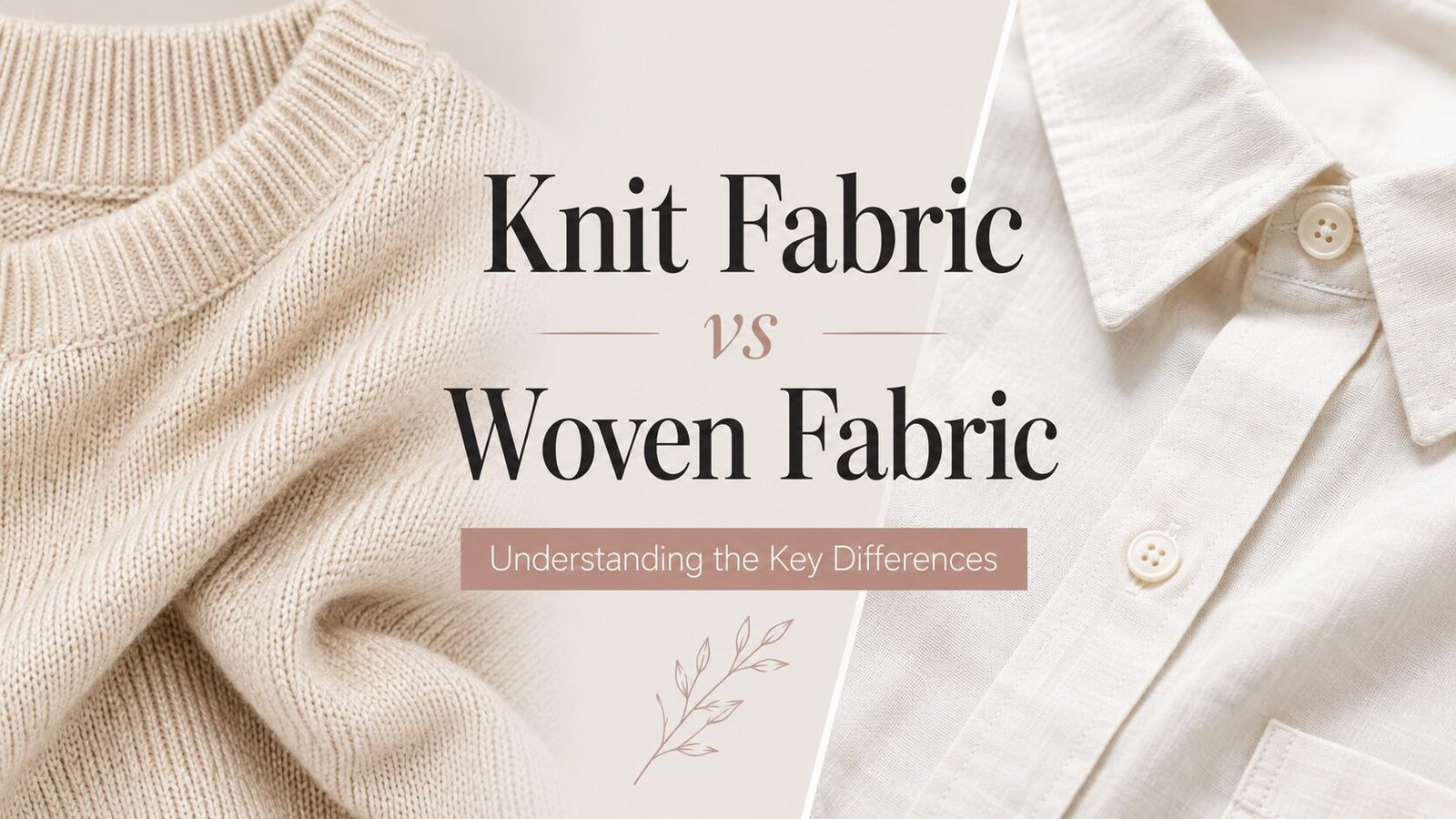
Have you ever wondered why your favorite T-shirt feels like a second skin, while your crisp button-down shirt keeps you looking sharp and put-together all day?
It all comes down to one fundamental choice in clothing design: knit fabric versus woven fabric.
While they might look similar at a quick glance, these two fabric types are made entirely differently, behave differently, and completely change how a piece of clothing fits and lasts. Let’s dive deep into what sets them apart.
Quick Reference Table
| Feature | Knit Fabric | Woven Fabric |
| Construction | Interlocking loops (one continuous yarn) | Crisscross grid (two sets of yarns) |
| Stretch | High (natural stretch) | Low (only stretches if spandex is added) |
| Wrinkles | Resists wrinkles easily | Wrinkles easily, needs ironing |
| Edges | Does not fray, but can unravel/run | Frays easily when cut, won’t run |
| Fit & Feel | Soft, body-hugging, casual | Structured, crisp, formal |
How They Are Made
The easiest way to understand the difference between knit and woven fabrics is to look at how the individual threads (or yarns) are put together.
Knit Fabrics: The Continuous Loop
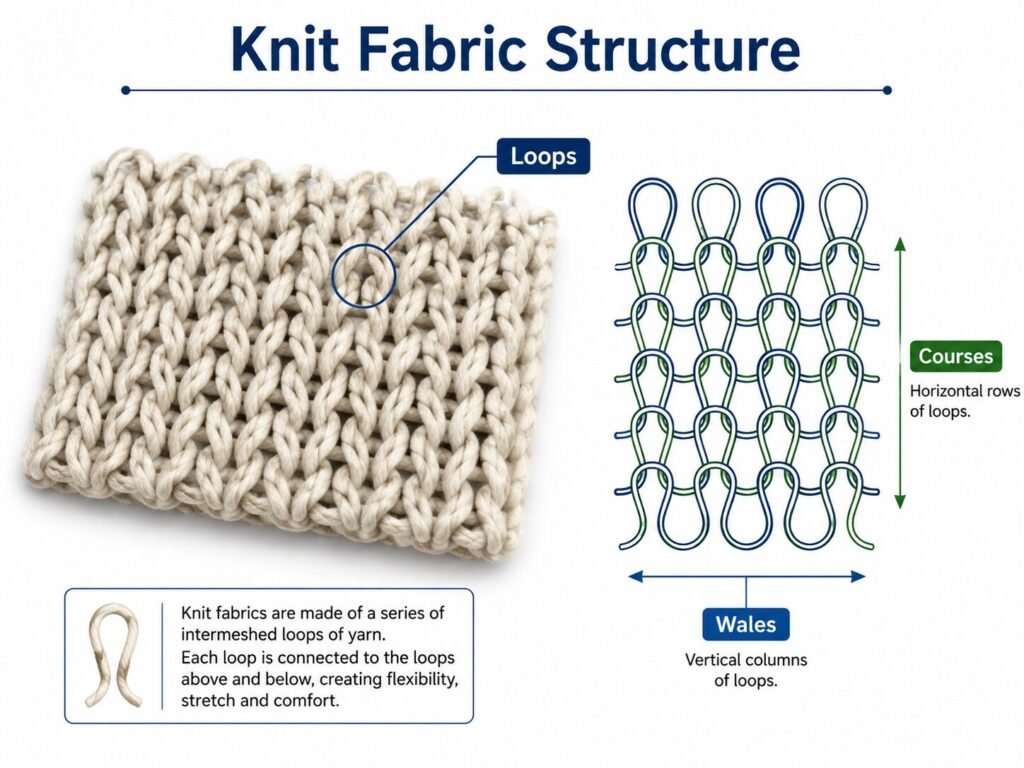
Think of a hand-knitted sweater, but scaled down to a microscopic level. Knit fabrics are made from one continuous thread that loops over and under itself. Because the structure consists of interconnected loops, there is naturally a lot of empty space between the threads. This looping structure is the secret behind the fabric’s famous stretch.
Woven Fabrics: The Grid System
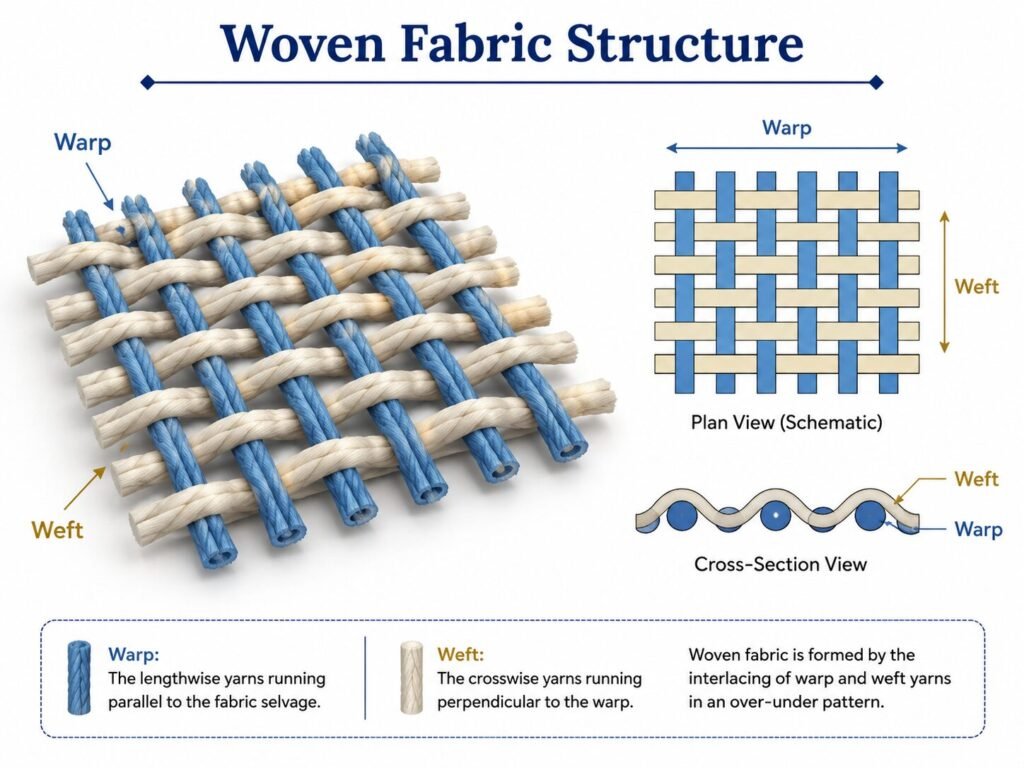
Woven fabrics are created on a loom using two sets of threads interlaced at right angles.
- Warp yarns run vertically (up and down).
- Weft yarns run horizontally (left to right).
They cross over and under each other in a strict, tight grid pattern (like a basket). Because the threads are packed tightly together with no built-in loops, the fabric is naturally rigid and stable.
The Key Differences
To really understand how these fabrics perform in real life, let’s break down their characteristics across five major categories.
Stretch and Flexibility
- Knit: Knits are the champions of stretch. Because of those interlocking loops, knit fabric can stretch in all directions—lengthwise and crosswise—and then snap back into shape.
- Woven: Traditional woven fabrics have almost zero stretch along the grid lines. They only have a tiny bit of give diagonally (called the “bias“). The only way a woven fabric becomes truly stretchy is if a flexible fiber like spandex (Elastane) is blended into the weave.
Wrinkle Resistance
- Knit: If you hate ironing, knits are your best friend. The looped structure allows the fabric to bend and crush without holding onto creases.
- Woven: Woven fabrics wrinkle easily. Because the threads are held tightly in place, any fold or crush forces the fibers to bend and stay that way until heat or steam relaxes them.
Breathability and Warmth
- Knit: Thanks to the spaces between the loops, air flows easily through knit fabrics, making them highly breathable. However, when made with thick yarns (like wool), those same spaces trap warm body air, making them incredibly cozy.
- Woven: The tight grid of a woven fabric acts like a barrier. It blocks the wind much better than a knit, but it can feel less breathable if the weave is very dense.
Fraying and Durability
- Knit: Knits don’t fray at the edges, but they do have a weak spot: if you snag a thread and break a loop, the fabric can “run” or unravel down the line (just like a nylon stocking).
- Woven: If you cut a woven fabric, the edges will instantly start to fray as the vertical and horizontal threads slip apart. However, the overall structure is incredibly tough, less likely to snag, and holds its shape for years without bagging out.
What types are there?
Let’s break down the most common types of knit and woven materials you wear every day and see why they behave the way they do.
Common Knit Fabrics & Garments
Jersey Knit:
This is the absolute king of casual wear. If you pull out a standard T-shirt, a lightweight summer dress, or your comfiest underwear, you are looking at jersey. It is a single-knit fabric, meaning it is knitted with one row of loops. This makes it incredibly lightweight, soft against the skin, and flexible enough to move with you without feeling restrictive.
Rib Knit:
If you look closely at the cuffs of your favorite sweatshirt or the collar of a beanie, you’ll notice raised vertical lines. That is rib knit. By alternating the loops back and forth, the fabric gains an incredible amount of extra stretch and elasticity.
It works perfectly for bands, collars, and form-fitting tops because it can stretch wide to let your head or hands through, and then snap tightly back into place so the clothing doesn’t stretch out over time.
Interlock Knit:
This is a heavier, premium option often found in high-quality hoodies, loungewear, and luxury athleisure. Unlike jersey, interlock is a double-knit fabric, which means it is created by knitting two layers of fabric together at the same time. The result is a thicker, sturdier material that looks completely smooth on both sides.
Common Woven Fabrics & Garments
Denim:
This is easily the most famous woven fabric in the world. Used for jeans and sturdy jackets, denim is traditionally made using a “twill weave.”
This specific tight crossing pattern makes denim incredibly heavy, dense, and resistant to tears and abrasions. It’s built to take a beating, which is why a good pair of jeans can last for a decade.
Poplin and Chambray:
These are the ultimate fabrics for sharp, professional clothing like business button-downs and crisp summer shirts. They use a “plain weave,” which is the simplest over-under grid pattern.
Because the threads are woven flat and tight, poplin and chambray feel very smooth and look clean and structured. They don’t stretch, which keeps you looking formal and put-together, though they do require a quick iron to get rid of wrinkles.
Satin:
Known for its luxury appeal, satin uses a complex weaving technique where several horizontal threads “float” over multiple vertical threads before dipping under. This long, uninterrupted surface of threads is what gives satin its famous, glossy shine and fluid drape.
It has virtually no stretch, but it flows elegantly, making it the go-to choice for evening gowns, luxury linings, and smooth pillowcases.
How to Quickly Distinguish?
If you are holding a piece of clothing and can’t figure out what it is, use these three simple tests:
- The Stretch Test: Give the fabric a firm tug. If it stretches easily in multiple directions and springs right back, it’s a knit. If it resists your pull and feels rigid, it’s a woven.
- The Wrinkle Test: Crush a handful of the fabric in your fist for five seconds. Release it. If it bounces back smooth, it’s a knit. If it leaves a crumpled mess of lines, it’s a woven.
- The Edge Look: Look at an unfinished edge or seam. Do you see loops or tiny frayed individual threads? Loops mean knit, threads mean woven.
Which one is better?
Neither fabric is “better” than the other—they just have completely different jobs.
If you are looking for comfort, flexibility, easy care, and a relaxed fit that moves with your body, knit fabric is the clear winner.
If you need structure, crisp lines, durability, and a classic look that holds its shape no matter what, woven fabric takes the crown. Knowing how each one behaves ensures you always pick the right tool for the job, resulting in clothes that feel great and look exactly the way they were meant to.